Lab 6: Pre-Lab
Your task in Unit 2 is to explore the factors that may affect metabolic rate (cellular respiration and photosynthesis). In the first lab (Lab 6) you will be designing two research proposals to help answer this question. Please review this pre-lab and external links to prepare for our in-class work. You will review the scientific method and research proposals, and learn about scientific posters. You will be choosing which experiment (respiration in Lab 7 or photosynthesis in Lab 8) to include in your scientific poster at the end of Unit 2.
What exactly will we be testing in lab?
Statistics Review & A New Test
Last week you started some background research on respiration and photosynthesis. This week we will move forward to the experimental design phase of the scientific method. You will begin constructing two "mini" research proposals to be used in the next two labs. Eventually, as discussed last week, you will select one of these projects to turn into a scientific poster.
Let's review statistics a bit! We used a correlation test for analysis in Unit 1. In Unit 2, we will use a t-test to analyze our results for both the respiration and photosynthesis experiments. A t-test is used to determine if the difference between two groups of data is significant.
Different is different...why do we need to run a t-test? A relationship is obvious...why do we need to run a correlation? We look for patterns to help us understand the natural world. As we do so, we are fighting our own human tendency to see patterns where none truly exist, and to take what we see in a specific context and try to apply it more broadly.
Let’s say you notice that within your friend circle, those who regularly eat breakfast did much better on their first BIOL 120 exam than those who skipped your morning meals together. You might then assume that somehow, eating breakfast is causing the better grades. But! Consider the following...
|

Read over this content carefully to review why we use statistical analysis as part of the scientific method.

Review the table below. Last unit we were focused on the "is there a relationship" type of question. Now we will focus on the "is there a difference" type of question.
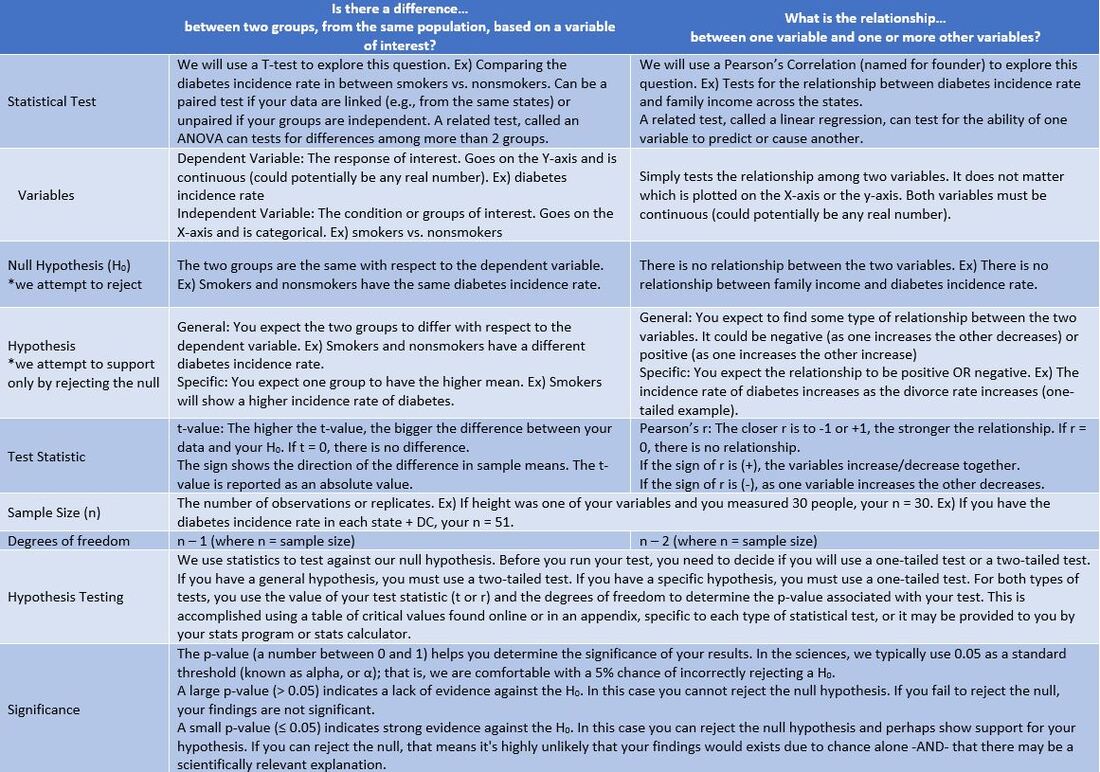
Comparing important concepts for each type of test. Click to enlarge. Review the statistics we will use and associated concepts in this table. Discuss the contents with your group and ensure everyone feels confident with material before moving on to the procedure.
|
Statistics solve this problem. Using the principles of probability, they help us parse what we observe from randomness (chance alone) vs. meaning (a real difference, or a real relationship). Statistics tell us how likely we would be to make the same observations we have made, if chance and randomness were the only drivers. If the probability is very low (<5%), we refer to these patterns as significant.
Do you know enough about posters?
You learned a lot about posters in Lab 6 part 1. The template below is specific to the poster assignment you will complete in few weeks over either Lab 7 or Lab 8.

Download and save the file below.

Open and review each section. You are provided detailed directions on what to include and where. Your post-labs from Labs 6 (I and II), Lab 7, and Lab 8, are all designed to prepare you for this assignment and help you complete each week by week. Your final job will be to put it all together into a poster.

Visit our library. Look over the section on scientific posters so you are aware of all the resources available.

This is the template for your poster. It is a PowerPoint file and can only be opened in PowerPoint. It is properly sized and includes specific directions for each section. Click here to open this file.
What will we do in lab and how will we do it?
We will be testing the rate of respiration (Lab 7) and the rate of photosynthesis (Lab 8) between two different groups. This set-up makes use of the t-test ideal for analysis. As a class you will get to make a few choices regarding the research question you will investigate and the variables you will explore.
1) Class Choice & Contract Revision (as needed): As a class you will decide what research questions to investigate in Lab 7 and Lab 8. You will be able to construct your own hypothesis for each lab. Once these decisions have been made, you can review your group contract. You likely learned many things about working with your group (strengths and weaknesses) that you should be reflected in a quick revision. In discussing the contract, you should decide which group members will take the lead on Lab 7 vs. Lab 8. They will be responsible for putting together the initial proposal, explaining their ideas to other members and for leading the experiment in each respective lab.
2) Create a Research Proposal on Respiration: You will explore available resources and your own sources to better understand your test organism, the crayfish, and the process of cellular respiration. You will use that research to construct your proposal, which will be submitted in your next LABridge.

Click to enlarge.
3) Create a Research Proposal on Photosynthesis: You will explore available resources and your own sources to better understand chloroplasts, photosynthesis and the light reactions. You will use that research to construct your proposal, which will be submitted in your next LABridge

Click to enlarge.

Think about what research questions you'd like the class to class to address. Would you rather take the lead on the respiration experiment or the photosynthesis experiment?

Look over the resources available to you in our Resource Library on crayfish, chloroplasts, cellular respiration and photosynthesis. Just get familiar, no need to dive-in to all the content just yet.
Once your class decides on the research question you will all pursue, you can individually decide on your own hypothesis. Regardless of your choice you will all use the class data and t-test for analysis. Remember! A t-test tests for the a significant difference between two groups of data. Specifically, we will be using an "unpaired t-test."

If you feel confident with this material, click the bridge icon and navigate to Blackboard to take the LABridge. You will not be submitting a Lab Notebook Entry for this LABridge.

Click here to get to WKU's blackboard to take your LABridge for this week. You will not be submitting a Lab Notebook Entry for this LABridge.
Lab 6: ProtocolYour task in Unit 2 is to explore the factors that may affect metabolic rate (cellular respiration and photosynthesis). In the first lab (Lab 6) you will be designing two research experiments to help answer this question. You will be choosing which experiment (respiration in Lab 7 or photosynthesis in Lab 8) to include in your scientific poster at the end of Unit 2.
Exercise I. Group Work Decision Exercise II. Proposal for Lab 7 Exercise III. Proposal for Lab 8 |

Lab 6 objectives: Following this lab you should be able to...(click to enlarge)
|
Exercise I. Class Choice & Contract Renegotiations

Click to enlarge.
|
Click to enlarge.
|
Procedure
- Review the images above. You will discuss these as class and make some choices about which research questions you would like to investigate over the next two weeks.
- Take some time to discuss how things went in Unit 1. What needs to change or be revised?
- In this lab you will be creating two research proposals. You should decide who will take the lead on Lab 7: Respiration and Lab 8: Photosynthesis.
- If you are leading the Respiration Project, begin Post-Lab Exercise II.
- If you are leading the Photosynthesis project, begin with Post-Lab Exercise III.
- Complete these proposals over the next week. Be sure to stay in touch with your partner.

Activity Roles for Group Work. Click to enlarge.
|

Group Contract Template. Click to download.
|
Exercise II. Construct Your Respiration Research Proposal
Big Picture! In this experiment you will be provided various crayfish to chose from. You will immerse them in a beaker of water so they may "respire." You get to decide to decide if you want to study temperature or glucose concentration.
|
Your primary task in Exercise II is to complete your research proposal for the respiration experiment to be performed in Lab 7.
Procedure
|

|
|
Section 1- Ask a Question: Begin by identifying your primary research question. This was decided on by the class! Remember, research questions can arise from observations in the field, in the lab, or from the scientific literature (e.g., scientific posters, presentations or papers).
Section 2- Research: You cannot create a "good" hypothesis without a potential rationale. You can only ascertain potential reasons "why" through research. You can include any relevant references you found in part 1 of Lab 6 in this section. You can also use the research library if you need more.
Section 3: A quality hypothesis must be objective, measurable and testable. It must also include a prediction and potential rationale (examples). Think about how your specific hypothesis and predictions connect with the larger body of research of crayfish and cellular respiration.
REMEMBER! You get to test your own hypothesis! Section 4: Experiments are designed to test the prediction accompanying your hypothesis. Your experimental design should identify your variables and their type based on your hypothesis. Experiments should be both valid and reliable. You have many decisions regarding the design of your experiment, but the general method is set and explained in detail in the Pre-Lab for Lab 7. Those details are not required in your research proposal.
How will we measure the rate of cellular respiration? ...By measuring the CO2 produced as a bi-product of the metabolic process! We will discuss this method more in Lab 7, but for now you just need to understand we will measure the rate of CO2 produced as an indication of the rate of cellular metabolism. |

Click here for a brief introduction to cellular respiration.

Click to enter research library.
|

There are also a set of additional factors you should consider in the presentation below. However, because of Covid-related time limitations you may not be able to run as many tests or trials as you'd like. Your TA will help you decide on the need for additional controls based on the research question selected by the class.
Exercise III. Construct Your Photosynthesis Research Proposal
Big Picture! In this experiment you will be provided a solution of active chloroplasts. You will subject those chloroplast to different environments, based on your research question, and measure the rate at which they perform photosynthesis.
|
Your primary task in Exercise III is to complete your research proposal for the photosynthesis experiment in Lab 8.
Procedure
|

|
|
Section 1: Ask a Question: Begin by identifying your primary research question. This was decided on by the class! Remember, research questions can arise from observations in the field, in the lab, or from the scientific literature (e.g., scientific posters, presentations or papers).
Section 2: Research: You cannot create a "good" hypothesis without a potential rationale. You can only ascertain potential reasons "why" through research. You can include any relevant references you found in part 1 of Lab 6 in this section. You can also use the research library if you need more.
Section 3: Section 3: A quality hypothesis must be objective, measurable and testable. It must also include a prediction and potential rationale (examples). Think about how your specific hypothesis and predictions connect with the larger body of research on photosynthesis and light.
REMEMBER! You get to design your own hypothesis! Section 4: Experiments are designed to test the prediction accompanying your hypothesis. Your experimental design should identify your variables and their type based on your hypothesis. Experiments should be both valid and reliable. You have many decisions regarding the design of your experiment, but the general method is set and will be explained in detail in the Pre-Lab for Lab 8. Those details are not required in your research proposal.
How will we measure the rate of photosynthesis? ...By measuring the NADPH produced by chloroplasts in the light reactions! We will discuss this method more in Lab 8, but for now you just need to understand we will measure the rate of NADPH produced as an indication of the rate of light reactions, an therefore photosynthesis. |

Click here for a review on photosynthesis.

Click to enter research library.
|
Your chloroplasts will be placed in test tubes with tricene buffer and DIP are necessary to measure the rate of photosynthesis. We'll discuss the details in Lab 8.
There are also a set of additional factors you should consider in the presentation below. Your TA will help you decide on the need for additional controls based on the research question selected by the class.
There are also a set of additional factors you should consider in the presentation below. Your TA will help you decide on the need for additional controls based on the research question selected by the class.

|
Lab 6 BIOL 120 CONNECTIONS Section 1.6: Doing Biology Big Picture 1: How to Think Like a Scientist BioSkillls 2: Reading & Making Graphs BioSkillls 3: Interpreting Standard Error and Using Statistical Tests BioSkillls 4: Working with Probabilities Chapter 9: Cellular Respiration Chapter 10: Photosynthesis |

The Department of Biology at WKU strives to create a dynamic, experiential learning environment, and to be a destination department for competitive undergraduate and graduate students, involving them in the process of science and preparing them for success in a global society. This website is intended solely for use of BIOL 121 students. The information here is copyrighted or within "Fair Use" under the scholarship or education exemption.
|
|